


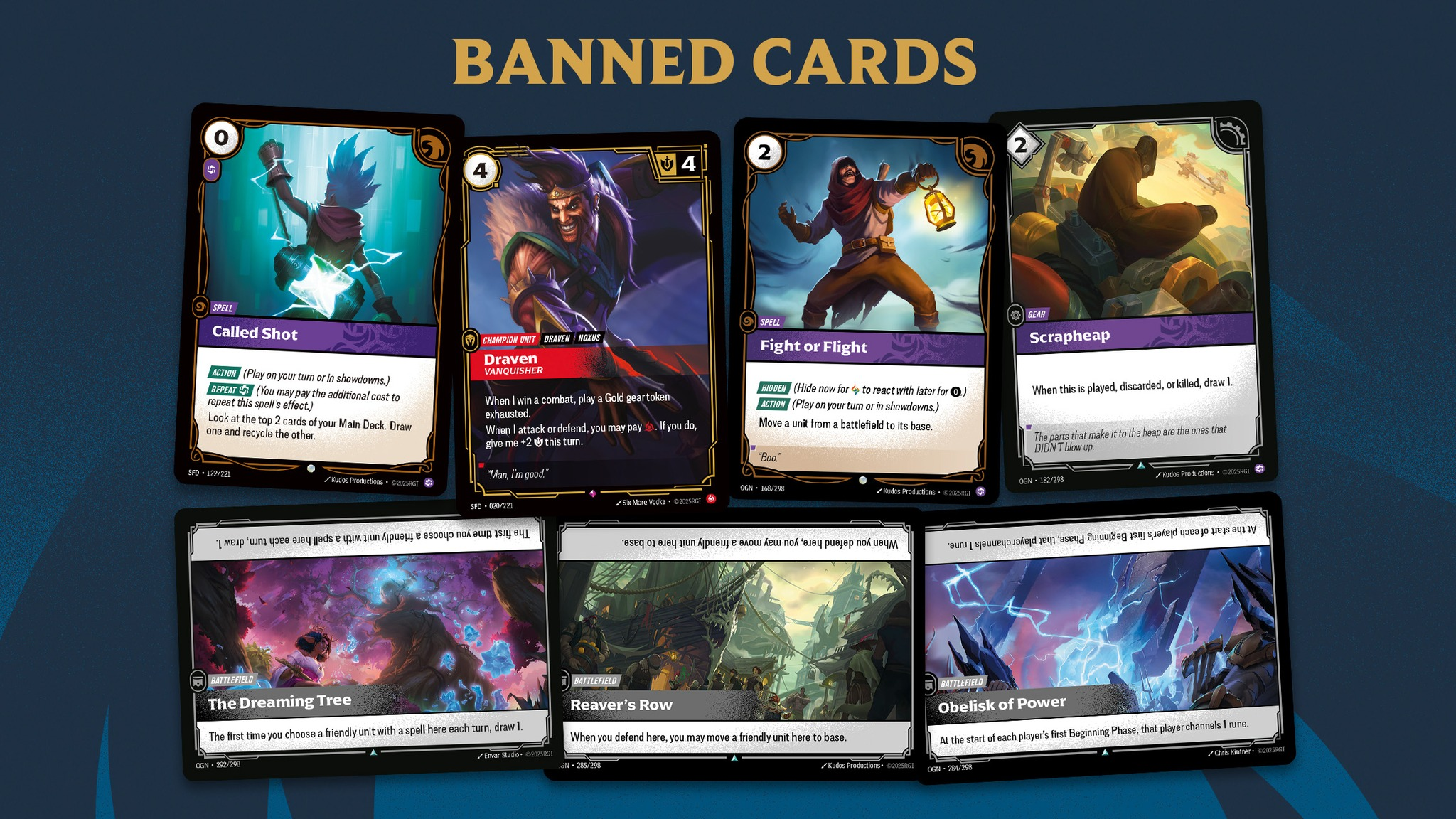
Banned cards: Called Shot, Draven-Vanquisher, Scrapheap, Fight or Flight, Obelisk of Power, Reaver’s Row, The Dreaming Tree.
A new meta is coming—let’s discuss fresh deck builds in the community!
Here is the official announcement video.
This video is reposted from the official Bilibili account of Riftbound China for community sharing only, not for commercial use. All copyrights belong to the official party. This account does not represent official views.
Explanation of Riftbound’s First Ban List Adjustment
Jon Moormann, designer of the Riftbound: League of Legends Trading Card Game series, will explain this round of banned card adjustments.
The following cards will be banned: Called Shot, Draven – Spinning Axe, Fight or Flight, Scrapheap, Reaver’s Row, The Dreaming Tree, Obelisk of Power
These cards will no longer be allowed in Constructed events, but can still be used normally in Draft and Sealed events.
This ban update will officially take effect on March 31.
The deck submission feature and card catalog display related to the banned card adjustments on the Riftbound WeChat Mini Program will also be updated in the near future.
We are fully aware that this ban will have a significant impact on players’ deck building and gameplay experience, and we have taken this decision with great caution.
The ban list was determined through long-term data monitoring and rigorous evaluation, with the core goals of optimizing the competitive meta, breaking meta dominance, and improving the in-game experience for all players.
The team will continue to monitor the impact of these ban changes on the game environment, listen closely to player feedback, and maintain open and transparent communication with the community.
Tournament Rules Update
meanwhile Vriss, bringing you the latest update to the Tournament Rules.
Since our last update, Riftbound: League of Legends Trading Card Game has welcomed many new players and judges to the community. We have been closely monitoring the progress of tournaments at all levels, while also gathering feedback from players and judges alike.
Our core goal is to ensure clear expectations for every Riftbound tournament, and to provide a fair and consistent experience for everyone—from Rift Nights all the way to the World Championship, without exception.
With that in mind, let’s walk through the key changes in this update and explain the reasoning behind them.
Our core goal is to ensure clear expectations for every Riftbound tournament, and to provide a fair and consistent experience for everyone—from Rift Nights all the way to the World Championship, without exception.
With that in mind, let’s walk through the key changes in this update and explain the reasoning behind them.
Further Clarification on Decision Changes and Judge Backtracking
Maintaining consistency across all regions has always been a key priority for us. This has become even more important as the game continues to grow and global events spanning multiple regions take shape—including our ultimate goal: the World Championship.
It is our responsibility to create clear, easy-to-understand rules so that players and judges share the same understanding, ensuring a highly unified experience no matter where you compete.
It is our responsibility to create clear, easy-to-understand rules so that players and judges share the same understanding, ensuring a highly unified experience no matter where you compete.
We have identified some inconsistencies in how players and judges interpret backtracking and decision changes. This update provides clear guidance on:
- Situations in which a player may change a decision after taking an action
- Situations in which a judge should issue a backtracking ruling
- The exact procedure for performing backtracking
When a backtrack is performed, the game state will revert to the point immediately before the corresponding game action was fully resolved.
With this clarification, both players and judges will have clearer expectations for specific scenarios.
With this clarification, both players and judges will have clearer expectations for specific scenarios.
Penalty System Refinements
This update also refines several new and existing penalties, including:
- Face-down card errors
- Extra draws
- Forgetting to set cards to Active during the Awaken Phase
- Deck list / deck presentation errors
In addition, we have made extensive adjustments to how warnings escalate to a game loss.
Riftbound is a deep, mechanically complex game. We aim to be lenient toward unintentional player misplays and allow reasonable margin for error, while also upholding competitive integrity to ensure fair matches.
For premier events:
- Warnings will now escalate to a game loss when a player accumulates multiple distinct warnings
- Warning records will no longer reset at the start of a new day within the same tournament
- Professional Play features the strictest thresholds for warnings escalating to a game loss
These updates reflect our expectation for top-tier events: to showcase the highest level of competitive play.
Asking Judges Rules Questions
Judges are an essential part of any tournament, tasked with supporting smooth event operations and ensuring full rule compliance.
During rules questions, it is critical that both players and judges reach a shared understanding.
During rules questions, it is critical that both players and judges reach a shared understanding.
This update adds guidelines specifying how judges should answer rules questions, ensuring players receive accurate guidance without being given strategic advice.
Judges may:
- Explain the rules and relevant card interactions
- Help clarify how rules function
Judges may not:
- Predict the outcome of specific actions in the current game
- Answer questions in a way that could constitute strategic advice
- Point out triggers, buffs, or battlefield elements a player may have missed (e.g., potential triggers, passive power bonuses, etc.)
With this in mind, players should frame their questions around specific rules or mechanics themselves, rather than asking, “What happens if I take a particular action?”
For clarity, here are examples:
Incorrect question:
“If I attack with my Tryndamere – Biting Fury and conquer this battlefield, will I earn the winning victory points?”
“If I attack with my Tryndamere – Biting Fury and conquer this battlefield, will I earn the winning victory points?”
Correct question:
“Can scoring abilities like Tryndamere’s be used to gain victory points?”
“Can scoring abilities like Tryndamere’s be used to gain victory points?”
As always, judges will continue to serve as the arbiters of the rules, and we ask that they be shown full respect. Remember, they are essential to keeping tournaments fair and enjoyable.
Additional Recall Clarification
We have noticed many players leaving recalled runes face-down on the battlefield to track unused mana.
While we appreciate the cleverness and convenience of this practice, it has also led to several issues, such as:
- Incorrect payment of costs
- Improper recall order for runes
Therefore, moving forward, when a card is recalled, it must be placed immediately at the bottom of its respective pile.
These are the headline changes!
For full details, the complete list of adjustments, and the full context of this update, please consult the official Tournament Rules document.
For full details, the complete list of adjustments, and the full context of this update, please consult the official Tournament Rules document.
See you next time—may your conquests be unstoppable, and your defenses unbreakable!